


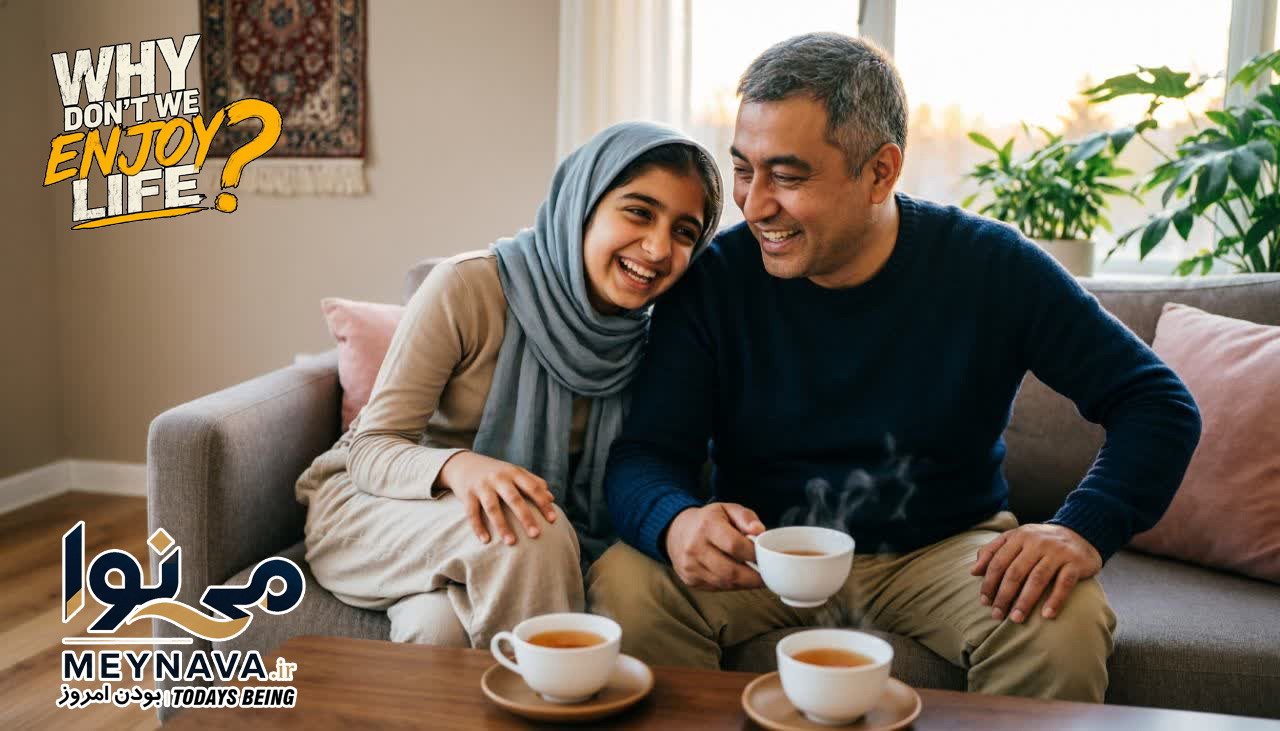
1. Two Fathers, Two Experiences
The class was over. The students were leaving the hall one by one. Iraj was standing by the board, gathering his things. Farhad was leaning against the wall in the hallway, phone in hand.
A few minutes later, Kazem came up the stairs. His old colleague, a man with gray hair and an old leather bag that was always with him. Kazem saw him and smiled: “Still here?” Farhad put his phone in his pocket: “Yeah, I had something to do.” A few seconds of silence. Then Farhad himself started the conversation: “By the way, Baran went on a trip. With the kids from the language class. North.” Kazem said: “You finally let her go?” Farhad paused: “Yeah.” Kazem said: “So?” Farhad smiled: “She had a great time. Since she got back, she’s better. We argue less. She laughs more.”
Farhad was genuinely happy. It could be heard in his tone. In how he talked about Baran’s laughter. In how he enthusiastically showed the photos Baran had sent. Kazem looked at him. For a few seconds. Then he said: “So you need to get used to it gradually.” Farhad raised an eyebrow: “To what?” Kazem said: “To her making her own decisions.” Farhad answered very quickly: “She always makes her own decisions.”
Kazem looked at him. He smiled. “Yeah… but you always have an opinion too.” Farhad laughed: “Well, I’m her father.” Kazem fell silent. He looked at the ground for a few seconds. Then he said: “Do you remember when my son got into university?” Farhad said: “Yeah. Tehran.” Kazem said: “The first three months I called him every day. To see how his classes were. What he ate for lunch. Whether the dorm was good or not. Every day.” Farhad said: “Well, that was natural.” Kazem said: “Yeah. But one day he told me: Dad, I know you love me. You don’t need to make sure every day.” He paused. “That day I understood many things.” Farhad said nothing. Kazem picked up his bag: “I have to go. Good night.” Farhad said: “Good night.”
Kazem left. Farhad stayed there.
2. Checking Five Times
Farhad walked toward the hallway window. He looked at the courtyard. A few students were sitting under the trees. One of them was explaining something with his hands. Farhad looked at them. Then he remembered Kazem’s words. “You don’t need to make sure every day.” It was true. He knew it was true. But something inside him resisted.
Kazem passed by the hallway once more. This time with his bag. Farhad called out: “Kazem.” He stopped. “Hmm?” Farhad said: “The day she wanted to go, I checked her schedule three times.” Kazem laughed: “I know.” He paused. “But maybe sometimes a person doesn’t need to make sure.” Farhad looked at him: “What does that mean?” Kazem shrugged: “Nothing.” Then he walked away: “I have to go. Good night.” Farhad said: “Good night.” Kazem left. Farhad stayed there.
“Maybe sometimes a person doesn’t need to make sure.” This sentence spun in his mind. He didn’t know why. Maybe because it was true. Maybe because he didn’t want it to be true.
3. The Message He Wrote and Deleted
Farhad left the university. The air was cold. The wind was blowing leaves across the sidewalk. He walked toward the car. He got in. He started the engine. He sat there for a few seconds. Then he picked up his phone. A message from Baran had come: “Dad, I’ll be late tomorrow. We have plans with the kids.”
Farhad looked at the message. His finger paused on the screen. He started typing: “Where are you going?” He looked at it for a few seconds. Deleted it. Typed again: “When will you be back?” Looked again. Deleted it again. Then he just wrote: “Okay.” He put the phone on the seat next to him. Started the engine. Drove off.
A few minutes later, at a red light, he picked up the phone again. He turned on the screen. Baran was not online. She had seen the “Okay” message. Farhad looked at it. A few seconds. Then he turned off the phone. Put it on the seat. The light turned green. He drove on.
4. A Photo from Age Eight
At night, Farhad was at home. Baran was out, with her friend. The house was silent. Farhad was sitting on the sofa. Laptop on the table. A book open, but unread. He was looking at the wall. At the photos on the shelf.
One of the photos showed Baran at a younger age. Maybe eight years old. Next to him. Both laughing. Farhad got up. He picked up the photo. Looked at it for a few seconds. In the photo, Baran was holding his hand. He remembered that day Baran even asked him which ice cream to choose: “Dad, which one should I get?” And Farhad had an answer. He always had an answer.
Now Baran was fourteen. She no longer asked about many things. She decided for herself. She went by herself. She came back by herself. And the strange thing was that this both made him happy and sad. Farhad put the photo back in its place. He looked at it for a few seconds. Then he went to the kitchen.
5. A Fear That Had No Name
He turned on the kettle. The sound of water echoed in the silence of the house. He looked at the window. Outside was dark. Streetlights on. A few cars passing. Farhad looked at them. Then, involuntarily, he thought about himself.
If Baran no longer needed him, who was he? For years, being a father had been a big part of his identity. Every morning he woke up and knew what to do. Taking care of Baran. Food, school, lessons, health. Now Baran had grown up. Gradually she did her own things. Gradually she made her own decisions. Gradually she moved away from him. Not in the sense that she didn’t love him. Not in the sense that she was distancing herself. Just in the sense that she was growing up. And Farhad didn’t know how to cope with this growing up.
The kettle boiled. Farhad poured tea. He picked up the cup. He sat by the window. He looked outside. He thought maybe Baran was no longer that girl from a few years ago. He thought maybe this was good. Then, involuntarily, he looked at his phone. He gave a short smile. He muttered: “What are you doing…”
He picked up the phone. He wrote: “Have fun.” He looked at the message for a few seconds. Then he sent it.
6. A Night He Slept Without Analyzing
Farhad put the phone on the table. A few moments later he picked it up again. He turned on the screen. There was no message. He put the phone back on the table. This time he didn’t pick it up. The sound of the kettle came from the kitchen. He got up. He turned off the kettle. He picked up his cup of tea. It had gone cold. He went to the sink. He washed the cup. Put it back in its place. He returned to the room. He closed the laptop. He turned off the light.
In the darkness, he lay on the bed. He looked at the ceiling. A white, smooth ceiling. It had no answer. Farhad closed his eyes. He thought maybe tomorrow he should talk to Baran. Maybe he should say that he knows she has grown up. Maybe he should say that he knows he can no longer control everything. Maybe he should say that he is afraid. But he didn’t know how. He didn’t know where to start. Maybe tomorrow. Maybe never.
The phone on the table lit up. A message. Baran: “Thanks Dad. Good night.” Farhad looked at the message. A few seconds. Then he wrote: “Good night, my dear.” He sent it. He put the phone down. He closed his eyes. And for the first time in a long while, without analyzing anything, he fell asleep.