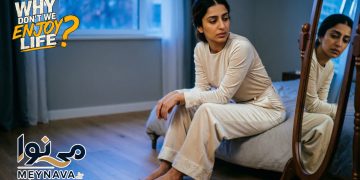



1. Every Night with Silence
The key turned in the lock, and the heavy door opened with a soft sound. Iraj stepped into the hallway. The house was silent—the same silence that had greeted him every night for fifteen years. Like a silent roommate who never speaks, but is always there.
He put his shoes by the door and tossed his bag onto a chair. He turned on the living room light. The white, even light revealed the books on the shelf, the desk, and the sofa. Everything was tidy.
He went to the kitchen and took a glass of water. He took a sip and looked at the wall clock. Eight thirty at night. One week until the anniversary. Fifteen years. It was almost slipping from his mind, but every year around these days, a stone in his chest grew heavier.
He put the glass on the table. He passed by the large frame on the table. A woman, two teenage boys, a little girl. All laughing. He averted his gaze, as always. He still couldn’t look at that photo and breathe.
2. A Smile from Behind the Glass
He walked down the hallway. He stopped by the shelf against the wall. A silver frame, larger than before, sat on it. A photo of a young girl, about twenty years old, with long hair and eyes that seemed fixed on something farther away than the camera. Her smile was calm—not that childish smile of eight years old. The smile of someone who had seen things, read books, and had questions in her head.
Iraj picked up the frame. He had taken this photo himself, a year before the accident, on a trip to the north. Leila was standing by the sea, looking at the horizon. The wind was messing up her hair, but she was indifferent, lost in thoughts Iraj never asked about.
This was Leila. Leila at twenty-two. An art student. In love with philosophy—but not her father’s philosophy. A philosophy that could be useful for life, as she herself used to say. Leila, who brought her father tea every night and sat listening to his words, but also spoke her own. Leila, who was stronger than her father, because she could speak, but could back up her words with her life.
Iraj looked at the photo. Fifteen years had passed, but he still couldn’t believe that this girl, with these eyes and these thoughts, was now asleep in a hospital bed. No, Leila had not died. But perhaps it was worse than death: she had gone, yet she had not gone. Like a book whose pages you have closed, but which is still on your shelf.
That night, the night before the accident, Leila was in her room reading a book. Iraj had heard her voice from behind the door, talking to herself. He thought maybe she was on the phone with her friend. But no, Leila was talking to herself. The next morning, before they got into the car, Leila had said to him: “Dad, today I want to tell you something. Promise me you won’t make fun of me this time.” Iraj had laughed and said: “I promise.” But Leila never told him.
He put the frame back on the shelf. Straight, not crooked. As always.
3. Full of Unanswered Questions
From the living room, he went to the end of the hallway. He opened the door. Leila’s room. But this room was no longer the room of an eight-year-old girl. Leila had grown up in this room. A bigger bed, shelves full of books, a desk with a laptop that was still on, and a wall covered with travel photos and movie posters.
Iraj entered. Everything was just as Leila had left it: a book on the table, a laptop whose screen was locked, a cup of dried-up tea on the desk, and a few cinema tickets pinned to a wooden board. Iraj had never moved anything. Not out of laziness, but out of the belief that maybe one day Leila would return and find everything just as it was.
He took a deep breath. In this notebook, Leila had lived. She had thought, asked questions, and answered. And Iraj, a father who studied philosophy, had never known what his daughter was writing.
He put the notebook back in its place. He looked at the laptop. The locked screen had a blue background with a sentence: “Life means being among questions.” Leila had chosen this sentence. Maybe to remind herself that asking is itself a way of living.
4. The Girl Who Wanted to Be a Philosopher
Iraj sat on the edge of the bed. He picked up the teddy bear that was still on the bed. But this time, next to it was a book: *The Aesthetics of Everyday Life*, translated by Iraj himself. Leila had read it and filled it with yellow and pink highlights and marginal notes. Iraj opened the book.
On one page, where it talked about “pleasure in simple things,” Leila had written in her own round, small handwriting: “Dad, read this part. It says a person can even enjoy a glass of tea. You always say I’m too emotional—look, this philosopher says the same thing.”
On the next page, in the margin: “But honestly, I still don’t understand why some people are so afraid of pleasure. Is pleasure a sin?”
And at the end of the book, in bolder handwriting: “Dad, when I grow up, I want to be a philosopher who is useful to people. Not like some who are only beautiful in their books.”
Iraj closed the book. He remembered that once, a few months before the accident, Leila had said to him: “Dad, with all your books, you still don’t know some things.” Iraj had asked: “Like what?” Leila had said: “Like how to talk to me.” Iraj had laughed, but she was right. Leila wanted him to be a father, not a professor.
Now, fifteen years later, Iraj knew Leila had been right. But to accept that, he would have to set aside all his books. And that was the hardest thing in the world.
5. I’m Still Waiting
He went back to the kitchen. He turned on the kettle. Tea for one. As every night. The sound of boiling water echoed in the silence of the house. He looked at the window. Outside, dusk was turning into night. The city lights were turning on one by one. For fifteen years, he had seen this same scene every night. But this time, something else was in his heart: not only hope for Leila’s awakening, but a question whose answer he never knew. What did Leila want to tell him? And why did she never say it?
He poured the tea into a cup and went toward Leila’s room. He stood behind the door. He looked at the doorknob for a few seconds. Then he opened the door and entered.
He sat on the chair beside the bed, where he sat every night. He put the cup of tea on the table and looked at the teddy bear. The teddy bear sat silently and motionlessly on the bed. But this time, his gaze fell on the red notebook. The notebook in which Leila had lived. She had spoken. She had asked questions. And Iraj had never asked what those words were.
He said softly:
“Dear Leila, today at the university one of the students asked about the good life… Honestly, I couldn’t answer. Not an answer that would be of any use to me.”
He paused. His voice echoed in the empty room.
“You always said I drown too much in my books. Maybe you were right…”
A moment of silence.
“You had promised that tomorrow you would tell me something… I’m still waiting. But I know you may never tell me.”
And for the first time that night, his voice trembled. But he did not cry. He had learned to cry over the past fifteen years; but he still didn’t know when he should cry.
He brought the tea to his lips and took a sip. The tea had gone cold. As always. Like all the years he had waited.
6. A Lost Girl
He put the cup on the table. He stood up and went to the window. Outside, the city had sunk into darkness. A few stars were visible in the sky. He stared at one of them. He remembered Leila’s words: “Dad, stars are the eyes of people who have gone and are watching us.” But this time, he thought maybe stars are the eyes of those who haven’t gone yet, but cannot say what they want.
He looked at the room. A room that had not frozen in time; a room in which Leila had lived, thought, and asked questions. And Iraj now knew that Leila was not just a lost girl; she was a human being with questions, with dreams, with words that were never spoken.
He ran his hand along the wall and turned off the room light. Darkness, calm and heavy, filled the space. He closed the door and returned to the hallway. He passed by the large frame; this time he did not avert his gaze. For a moment he looked at Sara, Amir, and Ramin and said:
“I had promised to take care of you… Maybe I couldn’t, but I will try to take care of Leila. Even if she can never tell me what she wanted to say.”
His footsteps echoed in the hallway and faded away. The house fell silent again. Only the sound of the refrigerator turning on and off remained.
And in Leila’s room, in the darkness, the teddy bear still sat on the bed. But this time, the red notebook was beside it, with pages that had not yet been read. And on Iraj’s phone, a message that had never been opened.